Search for “back casting room” and you’ll find a surprisingly mixed bag of results. Some describe a strategic planning space used by business leaders. Others reference casting rooms in metalworking or foundry work, or even the film and theater casting process. This guide focuses on the meaning that dominates most searches today: the back casting room as a strategic planning space built around the backcasting methodology.
A back casting room is a dedicated environment — physical, virtual, or hybrid — where teams work through a structured planning method called backcasting. Instead of predicting what’s likely to happen (forecasting), the room is built around a different question: if a team achieved its ideal future outcome, what had to happen to get there?
What Is a Back Casting Room?
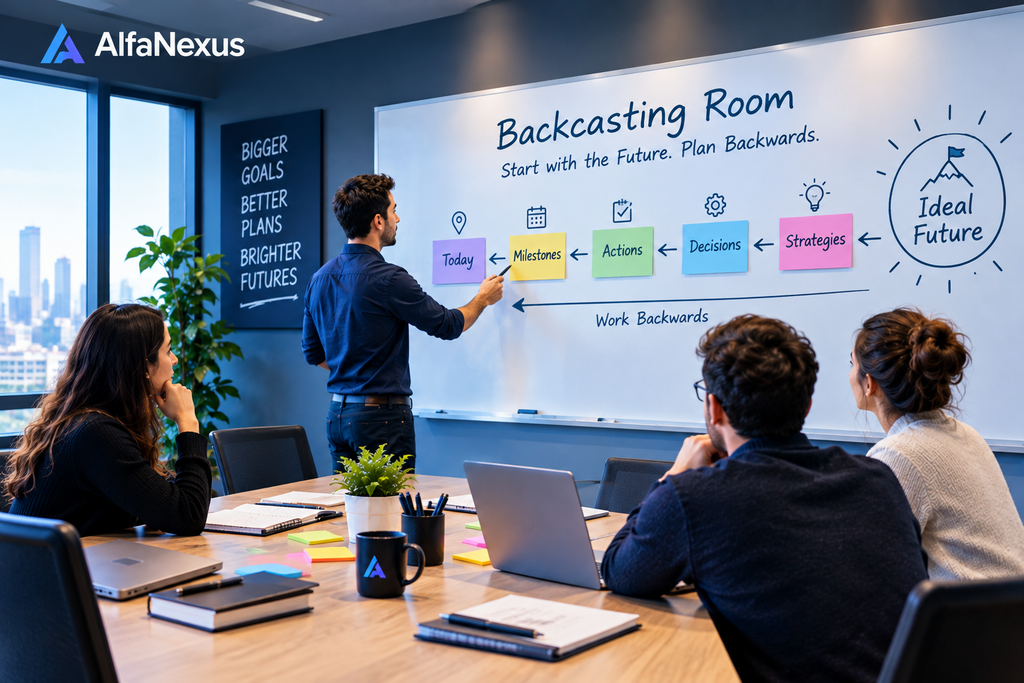
A back casting room is a workspace designed to support backcasting sessions — a strategic planning approach that starts with a defined future goal and works backward to identify the milestones, decisions, and actions required to reach it.
Unlike a standard conference room, a back casting room is set up specifically to support this backward-thinking process. It typically includes open wall space for mapping timelines, flexible seating for group discussion, and tools that make it easy to move ideas around as a plan takes shape.
Three Meanings of “Back Casting Room” (and Why This Guide Focuses on One)
Because “casting” has different meanings across industries, the term “back casting room” gets applied in a few unrelated contexts:
- Strategic planning (the primary meaning covered here): A room used for backcasting sessions, where teams define a future goal and plan backward from it.
- Metal casting or foundry work: In manufacturing, a “casting room” refers to a physical space where molten metal is poured into molds. “Back casting” isn’t a standard term in this field, though the phrase occasionally appears informally to describe a secondary or rear section of a foundry floor.
- Film and theater casting: Some informal usage connects “backcasting” to the casting process for actors, where a role’s traits are defined first and an actor is matched to fit them, rather than actors auditioning for a loosely defined part.
Search behavior and available reference material make it clear that the strategic planning interpretation is what most people are looking for when they search this phrase, so that’s the focus of the rest of this article. If you landed here looking for foundry equipment or film casting workflows, those industries use different terminology in professional settings, and it’s worth searching those specific terms directly for accurate, industry-specific guidance.
How Backcasting Differs from Forecasting
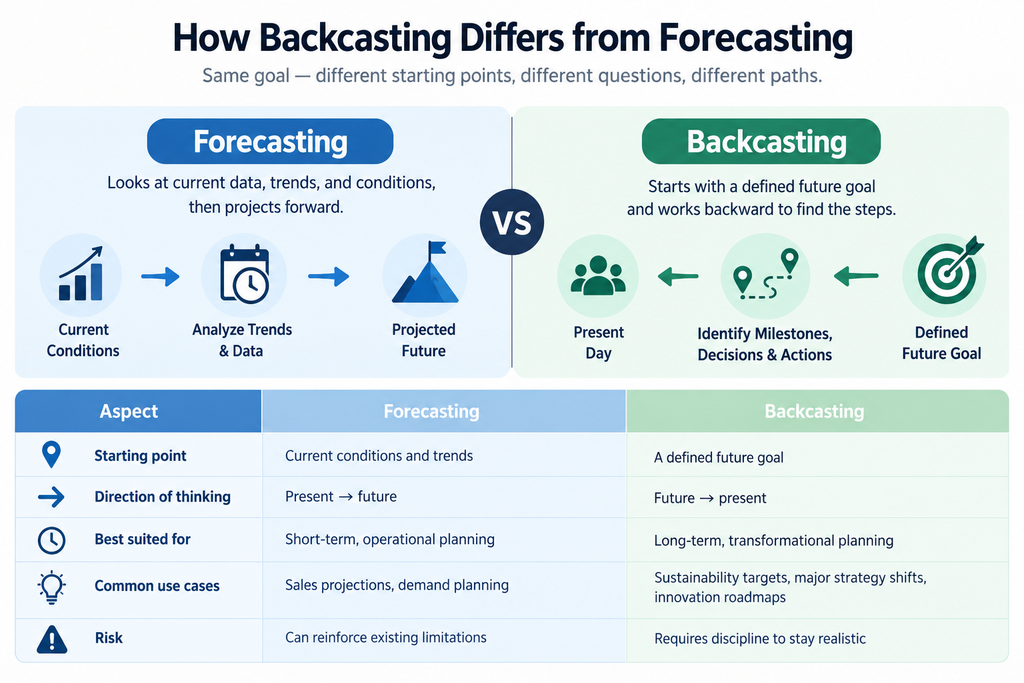
Forecasting and backcasting both aim to prepare organizations for the future, but they start from opposite ends.
Forecasting looks at current data, trends, and conditions, then projects forward. It answers questions like “If things continue as they are, what will next year look like?” This works well for short-term, operational planning where trends are relatively stable.
Backcasting starts with the destination. It answers a different question: “If we succeeded completely, what did we do to get there?” This approach is especially useful when the goal is ambitious, the timeline is long, or existing trends aren’t good enough to get an organization where it needs to be.
| Aspect | Forecasting | Backcasting |
| Starting point | Current conditions and trends | A defined future goal |
| Direction of thinking | Present → future | Future → present |
| Best suited for | Short-term, operational planning | Long-term, transformational planning |
| Common use cases | Sales projections, demand planning | Sustainability targets, major strategy shifts, innovation roadmaps |
| Risk | Can reinforce existing limitations | Requires discipline to stay realistic |
Most organizations don’t have to choose one over the other. Forecasting tends to guide near-term operational decisions, while backcasting is reserved for bigger, longer-horizon questions — which is exactly why a dedicated back casting room is useful. It creates a clear separation between “business as usual” planning and the kind of deep, future-focused thinking backcasting requires.
The Purpose of a Back Casting Room in Strategic Planning
The core purpose of a back casting room is to give a team the physical and mental space to think in reverse — starting from success and working backward — without the interruptions and habits of a regular meeting.
More specifically, this kind of room helps teams:
- Align around a single, clearly defined long-term vision
- Break an ambitious goal into smaller, sequenced milestones
- Surface hidden assumptions or constraints before they become problems
- Encourage input from people at different levels, not just senior leadership
- Keep a visual record of the plan that the group can revisit and revise
There’s also a less obvious benefit. Stepping into a space that’s clearly set up for long-range thinking — rather than a generic meeting room with a projector and a whiteboard — signals to participants that the conversation is different from a routine status update. That shift in mindset often makes people more willing to think ambitiously and speak candidly.
How the Backcasting Process Works, Step by Step
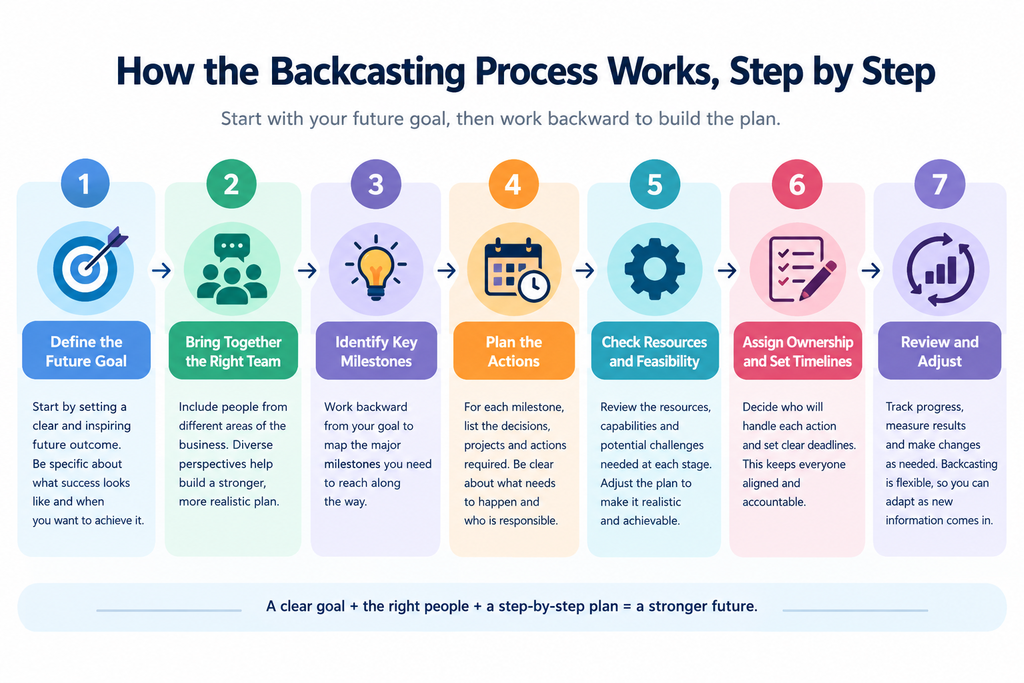
While the exact process varies by organization, most backcasting sessions follow a similar sequence:
- Define the future goal. The team agrees on a specific, ambitious outcome and a target date — for example, “carbon-neutral operations by 2035” or “fully automated fulfillment by 2030.”
- Describe what success looks like in detail. Rather than a vague statement, the team paints a detailed picture: What does the organization look like, operationally and culturally, once the goal is achieved?
- Work backward through time horizons. The team identifies what needs to be true five years before the goal, then three years before, then one year before, continuing backward until they reach the present.
- Identify key milestones and decision points. At each time horizon, the team pinpoints the specific actions, investments, or changes required.
- Test the plan against known constraints. Budget, staffing, technology, and regulatory realities are checked against the backward-mapped plan to make sure it’s achievable, not just aspirational.
- Assign ownership and next steps. The session ends with clear accountability — who’s responsible for the nearest-term actions, and when the plan will be revisited.
This backward mapping is usually done visually, often on a long wall or timeline template, which is one of the main reasons a dedicated back casting room is so useful. Rearranging ideas on sticky notes or a whiteboard is far easier than trying to manage the same process in a slide deck.
Essential Equipment and Tools
A back casting room doesn’t need to be expensive, but a few tools make the process significantly smoother:
Core essentials:
- Whiteboards or writable wall surfaces
- Large timeline templates (physical or printed) spanning the full backward-planning horizon
- Sticky notes in multiple colors, used to represent different categories of milestones
- Thick markers, visible from across the room
- A projector or large display for shared documents and data
Helpful additions:
- Digital collaboration boards for hybrid or remote participants
- Recording equipment, so sessions can be reviewed later without relying purely on notes
- Modular furniture that can be reconfigured between the discussion phase and the timeline-mapping phase
It’s worth noting that no single tool makes or breaks a backcasting session. A skilled facilitator with sticky notes and a blank wall will get better results than an unfacilitated group with a room full of technology.
Room Layout and Environmental Considerations
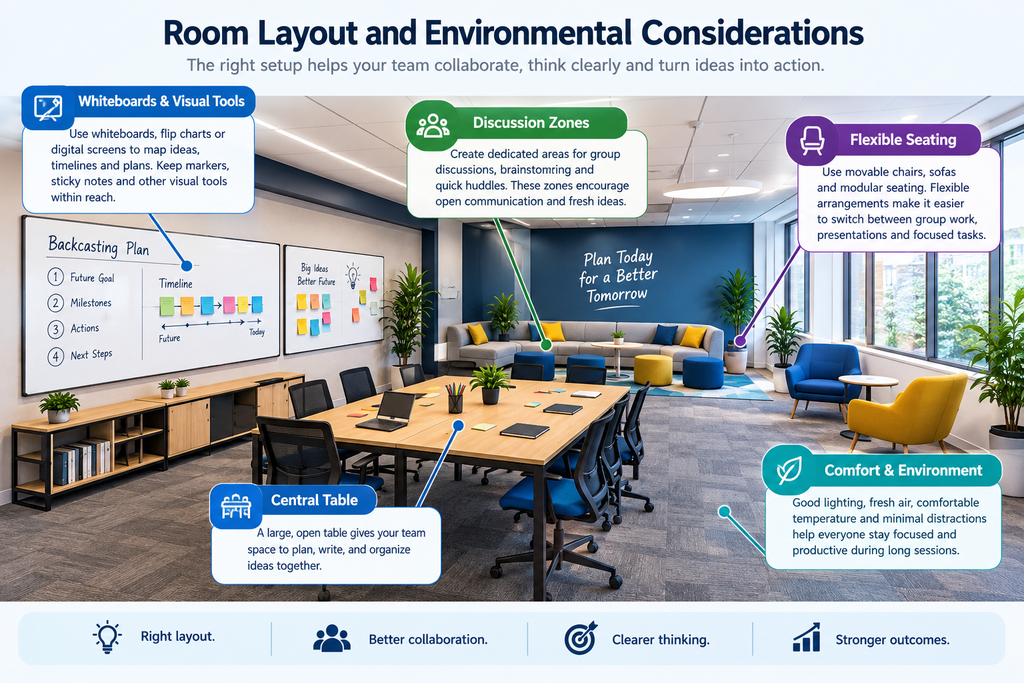
Seating and Spatial Flow
Rigid, forward-facing seating (like a classic boardroom table) works against the collaborative nature of backcasting. Circular or U-shaped seating arrangements tend to work better because they put everyone on equal visual footing and make group discussion feel natural rather than hierarchical.
Wall Space
Because most of the backward-mapping work happens visually, wall space matters more in a back casting room than in a typical meeting room. Long, uninterrupted stretches of whiteboard or writable wall let a team map an entire timeline without breaking it across multiple small boards.
Zoning
Many organizations find it useful to divide the room into informal zones:
- A vision zone, where the future goal is defined and displayed
- A timeline zone, where the backward-mapped milestones are built out
- A discussion zone, with more relaxed seating for debate and reflection
These zones don’t need physical walls — a change in furniture arrangement, lighting, or even wall color is often enough to create a mental shift between phases of the session.
Lighting and Comfort
Backcasting sessions frequently run for several hours, sometimes across a full day or more. Comfortable seating, good natural or adjustable lighting, and easy access to breaks all affect how well a team can sustain the kind of focused, creative thinking backcasting requires.
Who Uses a Back Casting Room
Several types of teams rely on backcasting, and each brings slightly different needs to the space:
Sustainability and environmental planning teams use backcasting to work toward long-term targets, such as emissions reduction or resource efficiency, where incremental improvement based on current trends usually isn’t enough to hit the goal.
Corporate strategy and executive leadership teams use a back casting room during major transitions — mergers, rebranding, market expansion — to define what success looks like years out before getting into budgets and timelines.
Product and innovation teams use backcasting to avoid building features nobody needs. By defining the ideal end-user outcome first, teams stay focused on what actually matters rather than adding complexity for its own sake.
Cross-functional workshop facilitators are often the ones responsible for designing and running sessions in the room itself, translating the backcasting method into a structured, time-boxed workshop.
Back Casting Room vs. a Standard Meeting Room
| Feature | Standard Meeting Room | Back Casting Room |
| Primary use | Routine updates, decisions | Long-range strategic planning |
| Seating | Fixed, often facing a screen | Flexible, circular or U-shaped |
| Wall space | Minimal | Extensive, used for visual mapping |
| Session length | Usually under an hour | Half-day to multi-day |
| Facilitation | Optional | Strongly recommended |
| Output | Meeting notes, action items | A visual, sequenced roadmap |
The difference isn’t just about furniture. A standard meeting room is built for efficiency — get through the agenda, assign action items, move on. A back casting room is built for depth — slow down, question assumptions, and build a plan that spans years rather than weeks.
How to Recognize a Well-Designed, Professional Setup
Not every backcasting session needs a purpose-built room, but a few signs indicate that a setup has been thoughtfully designed rather than improvised:
- The room has enough open wall or board space to map an entire timeline without breaking it into disconnected pieces
- Seating can be rearranged without disrupting the session
- There’s a clear, visible distinction between the “future vision” content and the “current state” content
- A facilitator — not just a note-taker — is guiding the discussion
- The plan produced at the end is visual and sequenced, not just a bulleted list of ideas
If a session produces a wall full of sticky notes with no clear time sequencing, or if the group jumps straight from “the goal” to “next quarter’s tasks” without mapping the steps in between, that’s usually a sign the process (or the room setup supporting it) needs refinement.
Common Challenges and Mistakes
Skipping the detailed future description. Teams sometimes state a goal (“be carbon-neutral by 2035”) without describing what that future actually looks like in practice. Without that detail, the backward-mapping step becomes vague and hard to act on.
Letting the plan stay aspirational. Backcasting is meant to produce a realistic path, not just an inspiring vision. Plans need to be checked against real budget, staffing, and technical constraints, or they risk becoming a wish list rather than a strategy.
Weak facilitation. Because backcasting asks people to think in an unfamiliar direction — starting from an uncertain future rather than known present conditions — sessions can drift without someone actively guiding the group back on track.
Treating the room as optional. Running a backcasting session in a cramped room with fixed seating and no wall space makes the visual, collaborative parts of the process much harder than they need to be.
Involving the wrong group. Backcasting works best with a mix of people who understand both the big-picture vision and the operational realities. A room full of only senior leadership, or only frontline staff, tends to produce a lopsided plan.
What Beginners Should Know Before Their First Session
Anyone attending a backcasting session for the first time should know that the process can feel uncomfortable at first. It asks participants to imagine success in detail before figuring out how to get there — a reversal of how most planning meetings work.
A few things help first-timers get more out of the experience:
- Come prepared to describe the future goal in specific, concrete terms — not just a slogan
- Expect the early part of the session to feel abstract; the concrete milestones come later, as the group works backward
- Be ready to challenge assumptions, including ones that feel like “the way things have always been done”
- Treat the visual timeline on the wall as a living document, not a final answer
Small teams and startups can benefit from backcasting just as much as large organizations. The process scales down easily — a small business doesn’t need a dedicated room, just a wall, some sticky notes, and a clear future goal to work backward from.
Benefits of Using a Back Casting Room
Organizations that use a dedicated space for backcasting sessions tend to see a few consistent advantages:
- Clearer, more actionable roadmaps. Breaking a long-term goal into backward-mapped milestones makes progress easier to track than a single, distant target.
- Stronger alignment. When everyone in the room helps build the same visual timeline, there’s less room for misinterpretation about what the plan actually requires.
- Reduced short-term bias. Because the process starts from the future rather than the present, teams are less likely to default to “what we’ve always done.”
- Earlier problem identification. Working backward through time horizons tends to surface obstacles — budget gaps, skill gaps, regulatory hurdles — well before they become urgent.
These benefits depend heavily on facilitation quality and the honesty of the group’s discussion. A back casting room supports the process, but it doesn’t replace the discipline needed to make backcasting genuinely useful.
A Quick Note on Other Uses of the Term
If you arrived here looking for a metalworking or foundry casting room, that field uses “casting room” to describe the physical space where molten metal is poured into molds — a setting focused on ventilation, safety equipment, and material handling rather than strategic planning. Similarly, if you’re researching how casting decisions are made in film or theater, that process typically falls under standard industry terms like “casting” or “character-driven casting,” rather than “backcasting.” Both topics deserve their own dedicated research, since the tools, environment, and safety considerations are entirely different from what’s described in this guide.
Conclusion
A back casting room isn’t defined by its furniture or technology — it’s defined by the kind of thinking it’s built to support. By starting with a clearly defined future goal and mapping backward toward the present, teams can avoid the trap of incremental, trend-bound planning and instead build roadmaps that are genuinely designed to reach an ambitious destination.
Whether that room is a dedicated physical space, a virtual whiteboard, or a repurposed conference room for an afternoon, the value comes from the process itself: define success in detail, work backward through time, and turn a distant vision into a sequence of decisions your team can actually act on.
Frequently Asked Questions
Is “back casting room” the same as “backcasting room”?
Yes. Both spellings refer to the same concept — a space used for backcasting sessions. “Backcasting” is typically written as one word in academic and business literature, though “back casting” appears frequently in casual search queries.
Do I need a dedicated room to do backcasting?
No. While a dedicated space helps, especially for larger or recurring sessions, backcasting can be done in any room with enough wall space and flexible seating to support visual timeline mapping.
How long does a backcasting session typically take?
Sessions generally range from half a day to two full days, depending on the complexity of the goal and the number of stakeholders involved.
Can backcasting be done remotely?
Yes. Digital whiteboarding tools can replicate much of the wall-space mapping used in a physical back casting room, making the process workable for remote or hybrid teams.
What’s the difference between backcasting and scenario planning?
Scenario planning explores multiple possible futures to prepare for uncertainty, while backcasting starts from one specific, desired future and maps the path to reach it. Organizations sometimes use both methods together.
Who should facilitate a backcasting session?
Ideally, someone experienced in strategic facilitation who isn’t the most senior decision-maker in the room. This helps keep the discussion balanced and prevents the process from defaulting to top-down planning.
Is backcasting only useful for sustainability goals?
No. While sustainability planning is a common use case, backcasting is also used in corporate strategy, product development, and organizational transformation whenever a goal is ambitious enough that current trends won’t get the organization there on their own.